
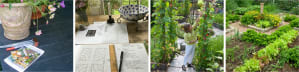
Hungering for Greens
A seed may look small, but what it becomes is bigger than you know.

“It is spring again. The earth is like a child that knows poems by heart” – Rainer Maria Rilke.


Welcome to The Art of Growing Food.
If you are a new subscriber, thank you for signing up. I’m Ellen Ecker Ogden, author of several books featuring kitchen garden designs with recipes for cooks who love to garden. In this column, I share ways to find beauty and artful elements for your kitchen garden design, helping you connect with the food you grow and your landscape. Follow my Vermont Garden on Instagram.
Hello Everyone,
If you have ever watched the first snowflakes fall from the sky, you might wonder how tiny wisps layered upon each other can form a formidable snowbank, as I did the other day. Watching snow accumulate is a reminder that each of us has the power to come together as a force. The same is true with drops of water forming the ocean, minutes on a clock that make up an hour, honeybees in a collective hive, and the seeds we sow each spring. When we participate in tiny acts that make up a bigger whole, we keep going with the work we are doing because we can make a difference.
While the world feels like it is falling apart, thinking about your garden and the seeds you will sow can bring solace. There is a reason why the seed catalogs arrive in January, when most of us are desperate to escape the winter, the snow, and, right now, the daily destruction of everything we know to be true and right. It’s hard to ignore the colorful photos of flowers and vegetables, tempting us to grow everything. Picturing your garden right now may offer a little escape, break the dormancy of winter, and it starts with choosing the right seeds to grow.


Seeds are powerful yet tiny, essential to life. As a gardener, knowing I can sow a seed and watch it grow into a plant still fills me with awe. Each seed forms a collective that matures into a garden full of beautiful edibles; alone, it would not have the same impact. Instead, we rely on a single packet filled with tiny seeds to meet our needs. And so, faced with all the options and knowing that I only have one chance to grow everything on my dream list in a single season, I’m putting a little extra effort into the decisions I am making right now.
After decades as a gardener, I still approach each garden season by choosing 80% tried-and-true and 20% new. And while I love to grow a bit of everything and somehow manage to pack a lot into a small space, I am slowly inching away from growing the “hard stuff” in favor of an easier and perhaps kinder approach to my garden. The “hard stuff” includes anything started early in a seed tray or under grow lights, or that requires special attention, such as watering, fertilizing, and staking. If it is a tender plant, coddling it until the sun's warmth and the threat of frost demand extra effort.


This year, I’m taking a new approach. I will no longer fret about the broccoli that goes to seed too quickly, the tomatoes that never ripen, or the zucchini that attracts squash beetles, because I plan to focus on growing only greens. Beginning with salad greens: arugula, chicory, and chervil, purple Osaka and Mizuna mustard, and lots of loose-leaf lettuce. There will be hard-to-find greens such as golden purslane, sorrel, bok choy, and cress (both land and water), celery, and mache. I’ll mix up packets of Mesclun from last year’s seed packets, and include herbs such as basil, dill, and fennel.
If it grows easily from seed and can be sown directly in the garden, and is cold-hardy, it is on the list. Making life easier by choosing seeds that grow quickly and with minimal fuss is my way of stepping back from the chaos and the extra planning it requires. By sowing a weekly succession of greens, I’m bound to have ample harvest, although I may lose a few plants, as I do every year, and it usually involves rabbits. But I plan to grow enough to feed us both.


Reflecting on the garden season ahead, I am hungry for greens. And the simple act of pressing a handful of seeds into the soft soil, watering, and watching green shoots emerge from the ground—active, robust, and alive — will make life a little easier this year. Learning to let go of the way I have always planted the garden in favor of a new method keeps the garden interesting.
The same goes for where you buy your seeds. Maybe it's time to look beyond the big mainstream catalogs in favor of smaller, family-owned regional seed catalogs that are popping up all over. Supporting these alternative seed companies is a way to honor diversity and the regional history that seeds represent. Seek out open-pollinated and heirloom varieties that offer exceptional flavor and will increase healthy pollinators in your garden.
Seeds are pre-equipped with everything they need to send forth a root, a shoot, and a leaf, and with very little effort. It’s a helpful reminder that we can choose the hard path or a slightly easier, kinder, and more compassionate one. In life, or in the garden. This can take the form of extra harvests delivered to a food pantry or inviting neighbors into the sanctuary of our gardens.
From my garden to yours,
Ellen Ecker Ogden


Ellen, I love that you're taking an easier approach this year. I'm trying this year to do more winter sowing so I don't have to rely on my grow lights this year for as many of my crops. And I love your 80/20 rule, and also your intent to grow heirlooms and from smaller purveyors. I was a customer and a huge fan of The Cook's Garden, and I love your dedication to growing food. Thanks for everything you've done for the gardening community, and for continuing to share your growing adventures. I hope your greens grow well for you this year! ❤️
This shift to simplicity makes alot of sense. Focusing on cold-hardy greens that self-seed with minimal fuss is a smart way to reduce stress while still getting good yields. I started doing succession planting for leafy stuff a couple years ago and honestly the continuous small harvests work way better than trying to time everything perfectly like I used too.