
Talking About Rhubarb.
Balancing a little wild with the predictable.


Hello Friends.
If you make a recipe over and over again, at a certain point, you may feel you don’t need to open that cookbook to check the ingredients. Which is what happened last Friday when, after harvesting an armload of rhubarb, I set about making a rhubarb coffee cake to take to a friend. I know this recipe by heart, I make it every spring when rhubarb is in its prime. But this time, by mistake, I added only one cup of flour instead of two.
The result, while not the usual cake-like texture, was instead thick and dense. The topping caramelized, so the edges were crispy. It was soft and gooey, and hard to cut out into pieces from the pan, so a spoon was required. My first thought was to discard it and make another, but after tasting, it was clear that this mistake was superior to the original recipe. Not exactly a coffee cake, yet it was unctuous and divine. My friend agreed, and we stood at the kitchen counter, unable to stop eating it.
These are the times I most enjoy, the mistakes that turn out well. This is also what I enjoy about my garden, every year a new opportunity to have failures and successes, but also to adjust the ingredients – plant peas earlier and basil later, more parsley, less arugula, endive instead of lettuce in summer. It’s a constant state of flux, and what gets planted in spring is no longer the same as the summer planting. Change is good in a garden. Remembering mistakes when they turn out well is the hard part.


Rhubarb is all about reliability and a never-fail attitude. From the first rosy knobs that push through the soil to the tender pink stems and abundant foliage, it is saying to the gardener and the cook, “I’m here again, happy to oblige.” I admit my rhubarb recipes are limited to cake and pie, with the occasional chutney or sweet sauce for ice cream, and when production outweighs appetite, it is chopped and frozen for winter. But it never has the same appeal. The time is now.
The rhubarb plant in my garden is a source of beauty and food, but also contains a history I can only imagine. It was here when I settled in two decades ago, and most likely had been growing for decades before. An unnamed heirloom its foliage spreads along a 10-foot side of the kitchen garden. Dividing rhubarb requires deep digging to capture the long, thick tap roots, which two people must pull and dig at the same time. Needless to say, once planted, it prefers to remain in place.
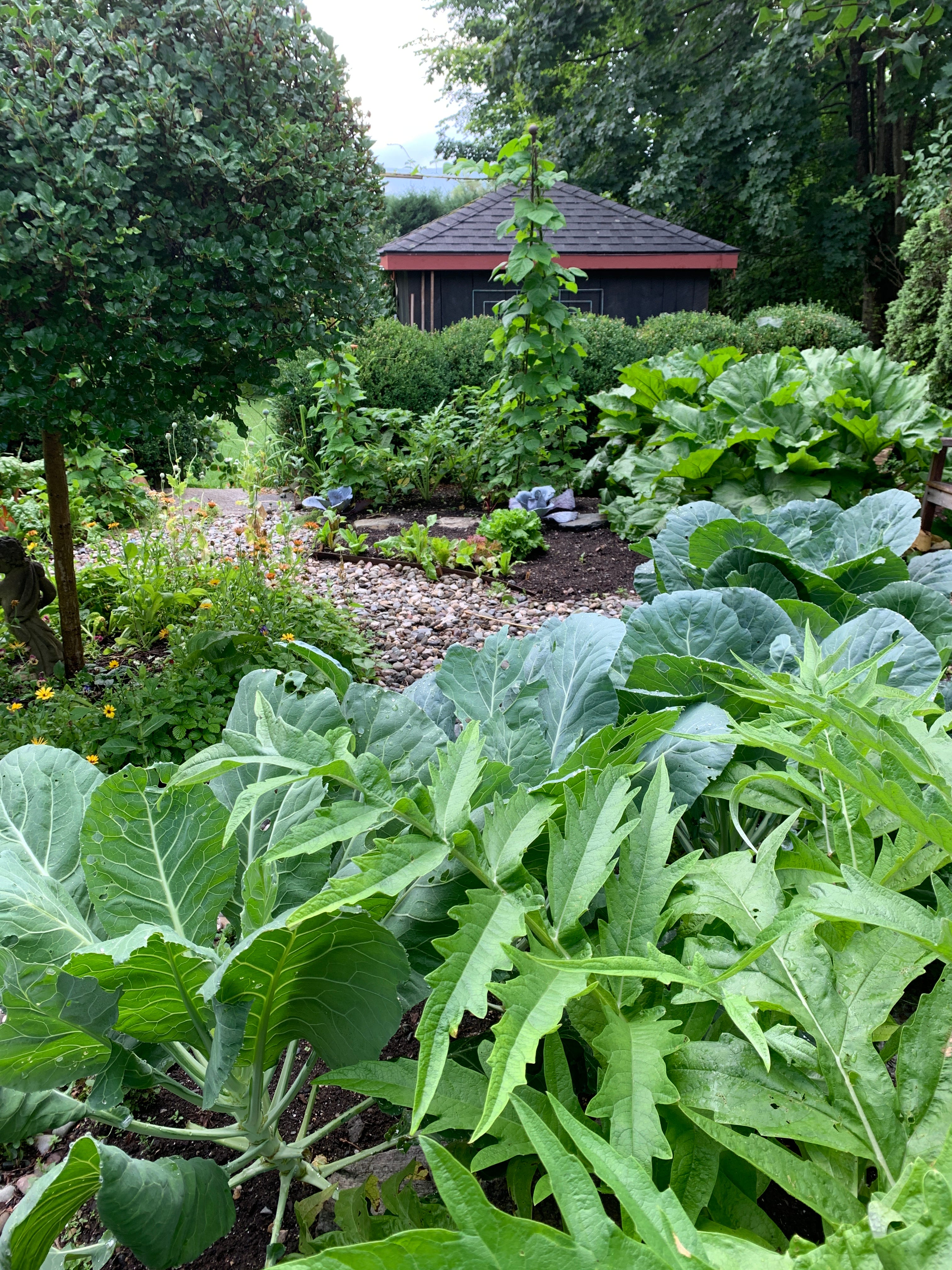
Rhubarb, along with asparagus, horseradish, berries, fruit trees, vines, and a range of other perennial edibles, are those old friends that come back every year. Ornamental and productive, they all perform like a well-synchronized orchestra, allowing the gardener to predict when the harvest season will begin and end. Most require only minimal pruning and care, yet in the case of rhubarb, no care at all.
After the first month of vigorous growth, giant seed heads form that will shut down the production of edible stems. Keeping them trimmed allows the plant to continue sending up new tender growth, which it will do until mid July, when the lush foliage forms a safe haven for slugs and toads. The latter keeps the former nicely under control.
My kitchen garden is a little unpredictable, similar to the way I like to cook. Yet the reliability of rhubarb keeps me on track. If you don’t already have a rhubarb plant growing in your garden, find a plant and make space. A healthy rhubarb plant will stretch wide, so give it berth. While I have seen rhubarb planted as a standalone in the yard, it is best to include it in an artful kitchen garden design.
From my kitchen garden to yours,
Ellen Ecker Ogden
p.s You can find my recipe for Rhubarb Coffee Cake here. And if you want to take a chance, try it with a cup less flour, and let me know what you think.


If you are a new subscriber, thank you for signing up. I’m the author of five books featuring artful kitchen garden designs with recipes for cooks who love to garden. For more info, go to www.ellenogden.com or follow me on Instagram.
Rhubarb grows so well in Southeast Alaska. Your piece was such a good reminder to act now and make something with it. I have a tried and true recipe that my daughter sent to me years ago; NYT rhubarb custard bars - it's delicious and I get to be artistic and decorate it with rhubarb "confetti" curls on top which adds a little color and whimsy.